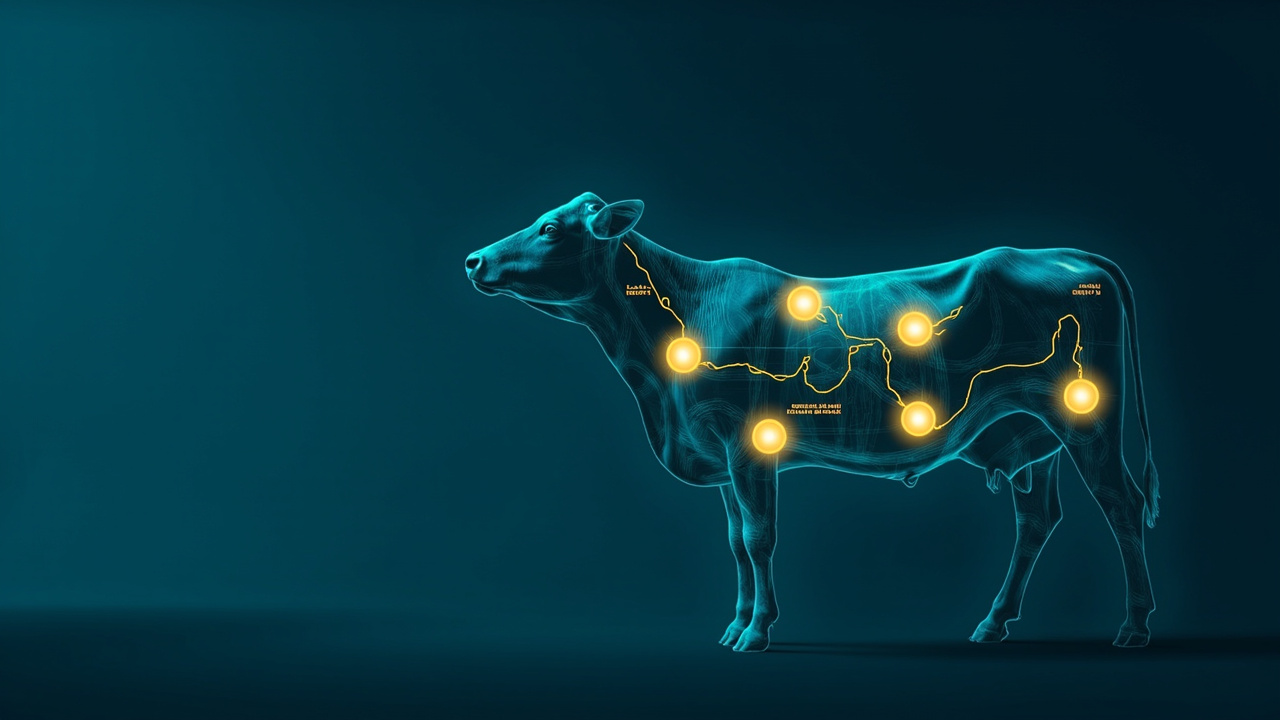
The Rumen Myth: Partial Protection, Not Complete Immunity
The most common misconception about ruminants is that the rumen fully protects them from mycotoxins. The reality is more nuanced: the rumen provides partial but incomplete protection. While rumen microorganisms can detoxify certain mycotoxins — converting DON to the less toxic DOM-1, for example — this process is never 100% efficient, and many mycotoxins pass through unchanged or are converted into metabolites that are actually more harmful.
The consequences of this partial protection are measurable: reduced feed intake, impaired immune function, fertility disturbances, and measurable losses in milk yield and quality. These are not edge-case scenarios — they are documented outcomes across multiple peer-reviewed studies.
Deoxynivalenol (DON): The Most Studied Threat
DON, produced by Fusarium graminearum and related species, is the most extensively researched Fusarium toxin in dairy cattle. Also known as "vomitoxin," DON disrupts protein synthesis at the cellular level by binding to the 60S ribosomal subunit, triggering the ribotoxic stress response that activates inflammatory cytokine cascades.
In dairy cattle, the absorption rate of DON is approximately 7–10% — far lower than in monogastrics — because rumen microbes efficiently convert it to de-epoxy-DON (DOM-1). However, this detoxification does not eliminate the risk:
- Subclinical doses reduce feed intake and rumination activity even when no outward symptoms are visible
- Chronic exposure suppresses immune function and upregulates pro-inflammatory cytokines, increasing susceptibility to mastitis and other infectious diseases
- Milk yield losses are documented even at dietary levels below established NOAEL values
- Carry-over into milk occurs as both DON and DOM-1 conjugates, raising food safety considerations for dairy product consumers
According to EFSA, the NOAEL for DON in dairy cows is 5 mg/kg feed — but studies show effects at lower concentrations when exposure is prolonged. The detection of DON metabolites in milk (33–80% conjugated DON, 73–92% conjugated DOM-1) confirms that dietary exposure translates into measurable milk contamination.
Zearalenone (ZEN): The Estrogenic Risk
Zearalenone is structurally similar to 17β-estradiol, allowing it to bind estrogen receptors and trigger estrogenic responses. In dairy cattle, this manifests as disturbed estrous cycles, reduced conception rates, pathological changes in the reproductive tract, and impaired spermatogenesis in bulls.
The rumen converts ZEN primarily into α-zearalenol (α-ZEL) and β-zearalenol (β-ZEL). Critically, α-ZEL is approximately 60 times more estrogenically potent than ZEN itself, while β-ZEL is considerably less potent. Under in vivo conditions in cattle, β-ZEL predominates in the bile (68–76%), which provides some natural mitigation. However, α-ZEL still represents 6–13% of biliary ZEN metabolites — sufficient to cause measurable reproductive effects at high contamination levels.
In vitro studies with bovine neutrophils demonstrated that ZEN exposure induces oxidative stress, compromising the animal's defense mechanisms against pathogens. This immunomodulatory effect is often overlooked in field conditions.
Fumonisins: The Underestimated Risk
Fumonisins (FB1, FB2, FB3) disrupt sphingolipid metabolism by mimicking sphinganine and sphingosine, causing cytotoxicity, hepatotoxicity, and nephrotoxicity. The good news: ruminants absorb fumonisins poorly, and this is the primary reason they are considered less sensitive than pigs or horses.
However, "less sensitive" does not mean "insensitive." Documented effects in cattle include:
- Changes in liver function parameters at dietary levels as low as 148 mg/kg FB over 31 days
- Disruption of sphingolipid metabolism at 90 mg/kg over 110 days, even without clinical symptoms
- Reduced milk yield in Holstein and Jersey cows
- Hepatotoxicity and biliary duct hyperplasia in neonatal calves at 1 mg/kg intravenous FB1 over 7 days
Fumonisins pass through the rumen largely unchanged, which means rumen-protected feeds offer no advantage against this toxin family. Any fumonisin present in feed ingredients reaches the small intestine intact.
What This Means for Feed Formulation
The practical implication of the Gallo et al. (2022) review is clear: mycotoxin risk in dairy cattle is real, measurable, and not adequately addressed by rumen function alone. Feed mills and dairy operations should apply the same risk management principles used for monogastric species, particularly in regions with warm, humid climates where Fusarium contamination in corn, wheat, and other feed grains is endemic.
Key risk management strategies include:
- Regular mycotoxin testing of incoming feed ingredients, not just finished feeds
- Multi-toxin binder programs that address DON, ZEN, and fumonisins simultaneously — single-mode binders are insufficient
- Buffered mycotoxin interventions for high-contamination periods, such as early harvest seasons or drought-stressed crops
- Monitoring milk quality parameters — somatic cell count increases and milk protein reductions can signal subclinical mycotoxin exposure
Conclusion
The assumption that ruminants are immune to mycotoxins because of rumen fermentation is not supported by the scientific evidence. DON, ZEN, and fumonisins all produce measurable effects in dairy cattle, and the economic impact — through reduced milk yield, impaired fertility, and increased disease susceptibility — is often underestimated because it operates at subclinical levels.
ToxyFix and ToxyFix Plus are formulated to address broad-spectrum Fusarium toxin risk in dairy cattle rations, including the specific challenges of DON, ZEN, and fumonisin co-occurrence. Contact our technical team to discuss a risk assessment for your operation.
This article is based on peer-reviewed research published in Dairy journal. Gallo A, Mosconi M, Trevisi E, Santos RR (2022). Adverse Effects of Fusarium Toxins in Ruminants: A Review of In Vivo and In Vitro Studies. Dairy, 3(3), 474–499. https://doi.org/10.3390/dairy3030035