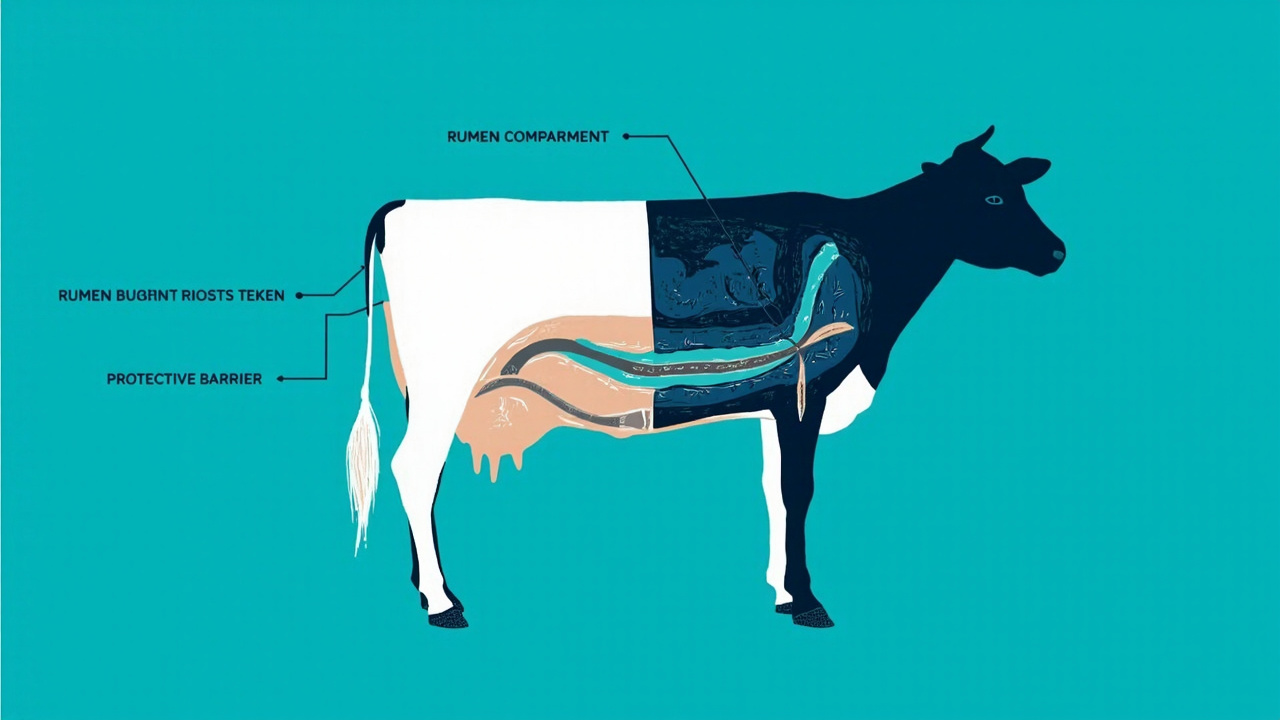
Why Rumen Protection Is Real But Incomplete
The rumen is a remarkable organ. Its microbial ecosystem can convert deoxynivalenol into the far less toxic de-epoxy-DOM-1, transform zearalenone into less potent metabolites, and neutralize a range of other mycotoxins before they reach the small intestine. But this natural defense has well-documented limits — limits that, when exceeded, leave dairy cattle unprotected at the exact moment they need it most.
The paper by Gallo, Mosconi, Trevisi, and Santos (2022) — a review of in vivo and in vitro evidence — documents the specific scenarios where the rumen's protective capacity fails, and what those failures mean for dairy operations.
Scenario 1: High-Level DON Exposure Exceeds Rumen Capacity
The rumen's ability to convert DON to DOM-1 is efficient under normal conditions — up to 81–93% of the DON flowing through the rumen is converted to DOM-1 in adapted animals. However, this conversion rate is not instantaneous, and in high-throughput conditions (such as early lactation cows consuming large volumes of feed), the metabolic capacity of rumen microorganisms can be temporarily exceeded.
EFSA's scientific opinion notes that effects attributable to DON ingestion in dairy cows — including anorexia, reduced feed intake, reduced rumination, immunosuppression, and pro-inflammatory cytokine upregulation — are documented even in the presence of rumen detoxification. This suggests that the rumen's partial protection is insufficient to prevent metabolic disruption at commercially relevant contamination levels.
Scenario 2: ZEN Converts to a More Potent Metabolite
Zearalenone is converted by rumen microorganisms primarily into β-zearalenol (β-ZEL), which is considerably less potent than the parent compound. However, a fraction is also converted into α-zearalenol (α-ZEL) — and α-ZEL is approximately 60 times more potent than ZEN itself.
The proportion between these metabolites is not fixed. Research shows that feed intake levels and rumen pH both influence the ZEN-to-α-ZEL conversion ratio. In early lactation, when rumen pH can be subclinicaly depressed due to high-concentrate diets, the conversion pathway may favor α-ZEL production — paradoxically increasing estrogenic potency in the very animals under the most metabolic stress.
Scenario 3: Fumonisins Bypass Rumen Detoxification Entirely
Fumonisins are notably different from DON and ZEN in that they are not significantly degraded by rumen microorganisms. FB1, FB2, and FB3 pass through the rumen-reticulum compartment largely unchanged and are absorbed in the small intestine. This means the rumen provides essentially no protection against fumonisin toxicity.
In dairy cattle, fumonisin exposure at 148 mg/kg feed for 31 days produced measurable changes in liver function. At 90 mg/kg over 110 days, sphingolipid metabolism was disrupted — despite no visible clinical signs. For operations using corn or corn by-products from warm-climate regions, fumonisin risk in ruminants should be assessed with the same rigor applied to monogastric feeding programs.
Scenario 4: Rumen Dysbiosis Compromises Detoxification Capacity
The rumen's mycotoxin-detoxifying capacity depends on a healthy, functional microbial community. Any factor that disrupts rumen microbiology — subacute ruminal acidosis (SARA), antimicrobial treatments, abrupt diet changes, or heat stress — can reduce the efficiency of DON-to-DOM-1 conversion and other detoxification pathways.
Heat stress is particularly relevant for operations in the Middle East and Sub-Saharan Africa. During periods of heat stress, rumen motility slows and feed intake drops, potentially altering microbial populations and reducing detoxification efficiency precisely when the animal's immune system is already stressed.
Scenario 5: Combined Mycotoxin Exposure Creates Additive Effects
In commercial feed ingredients, multiple mycotoxins almost always co-occur. The interaction between DON, ZEN, and fumonisins in the ruminant gut is not simply additive — it can be synergistic. Gallo et al. (2022) note that the concurrent presence of multiple Fusarium toxins can:
- Amplify immunosuppressive effects beyond what individual toxins would cause
- Compromise barrier function of the rumen and intestinal epithelium simultaneously
- Increase pro-inflammatory cytokine production through overlapping mechanisms
- Reduce nutrient digestibility in ways that compound energy deficit during early lactation
Co-contamination scenarios are the norm in field conditions, not the exception. A binder optimized for DON alone will leave ZEN and fumonisin effects unaddressed.
What Effective Risk Management Looks Like
The practical response to these five scenarios is not to rely on rumen function alone, but to build a risk management program that accounts for the specific vulnerabilities documented in ruminants:
- Test ingredients for the full mycotoxin panel — not just DON. ZEN and fumonisins are equally important for dairy operations.
- Use multi-modal binder technology — clay-based adsorbents for fumonisins, organic sequestrants for ZEN, and broad-spectrum activity for DON and its metabolites.
- Protect rumen function — avoid SARA, manage heat stress, and support fiber intake to maintain the microbial populations that provide first-line detoxification.
- Monitor milk quality — somatic cell count spikes, milk protein declines, and reduced cheese yield can signal subclinical mycotoxin exposure that is not apparent from feed intake measurements alone.
- Consider mycotoxin risk by ingredient — corn and corn by-products carry the highest fumonisin load; wheat and barley carry DON and ZEN risk; complete feeds require full-panel testing.
Conclusion
The rumen provides genuine partial protection against many Fusarium mycotoxins — but five specific, documented scenarios demonstrate that this protection is far from complete. Operations that assume ruminants are immune to mycotoxin risk are leaving themselves exposed to subclinical losses in milk yield, fertility, and immune function that never appear in any feed cost calculation but show up as quiet economic drag on the business.
ToxyFix Plus is formulated with dual-action technology to address the specific protection gaps that rumen function cannot cover — including fumonisin bypass and ZEN metabolite activity. Contact our technical team for a ruminant-specific risk assessment.
This article is based on peer-reviewed research published in Dairy journal. Gallo A, Mosconi M, Trevisi E, Santos RR (2022). Adverse Effects of Fusarium Toxins in Ruminants: A Review of In Vivo and In Vitro Studies. Dairy, 3(3), 474–499. https://doi.org/10.3390/dairy3030035