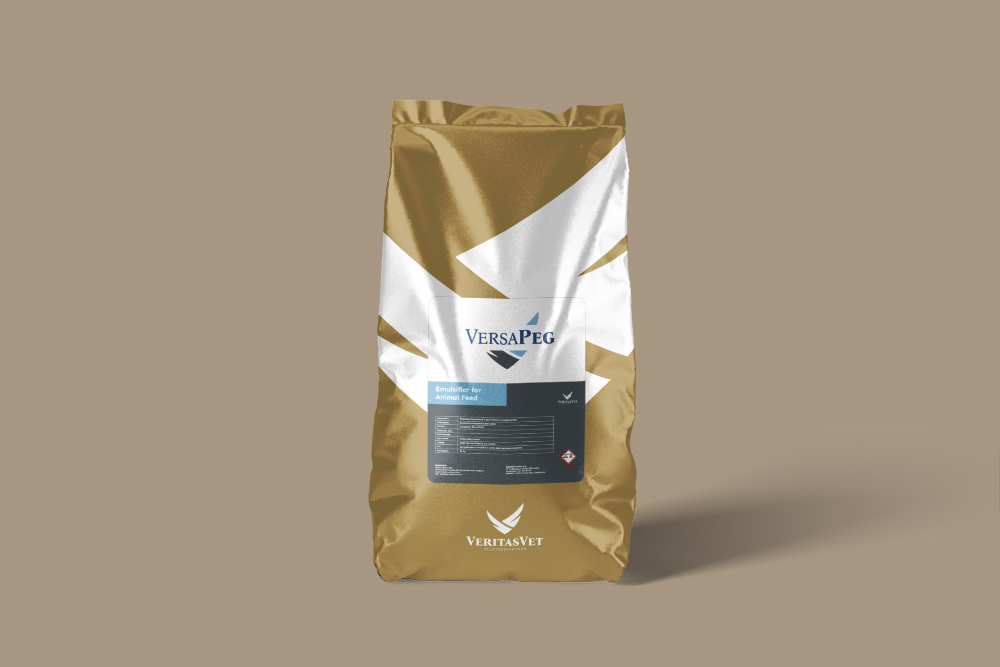
VersaPeg
Non-Ionic Water Soluble Emulsifier — Enhancing Fat Digestibility and Energy Efficiency
VERSAPEG is a premium non-ionic emulsifier in powder form made with polyoxyethylene glycol-glyceryl ricinoleate (E484). Its high lipophilic nature makes it an excellent emulsifier for fats and oils in feed, enhancing fat digestibility, improving energy efficiency and optimizing overall feed performance for livestock, poultry and fish.
Key Benefits
- Enhanced Fat Digestibility — E484 improves emulsification of fats for better breakdown and absorption
- Boosted Nutrient Absorption — promotes absorption of fat-soluble vitamins A D E and K
- Cost-Effective Nutrition — improves nutrient digestibility and energy efficiency while reducing feed costs
- Optimal HLB Balance — ensures effective interaction with both water and fat enhancing feed formulation stability
Dosage
0.250–1 kg per ton of feed. Suitable for complete feeds supplements and premixes.
How VersaPeg Works
VersaPeg functions as a non-ionic emulsifier by reducing the surface tension between fat droplets and the aqueous phase in the digestive tract. Its HLB (Hydrophilic-Lipophilic Balance) value of approximately 14–15 makes it particularly effective at stabilizing oil-in-water emulsions common in poultry and ruminant feed digestion.
In poultry, where bile salt secretion can be limited — especially in young birds — VersaPeg compensates by physically emulsifying dietary fats, enabling lipase enzymes to access triglyceride molecules more efficiently. This results in measurably higher fat digestibility coefficients, particularly for saturated fats commonly used in broiler feed formulations.
For ruminants, VersaPeg improves fat utilization in the abomasum and small intestine, complementing the natural emulsification that occurs through bile secretion. In aquaculture feeds — where fish oil and plant oil blends are standard — VersaPeg ensures stable emulsion formation even at the low temperatures used in pellet cooling.
VersaPeg vs. Alternative Emulsifiers
Lecithin-based emulsifiers are widely used but vary significantly in phosphatidylcholine content and efficacy. VersaPeg (E484) offers consistent, batch-to-batch performance without the variability associated with natural lecithin sources. Compared to bile salt supplements, VersaPeg works synergistically with endogenous bile rather than replacing it, making it suitable for long-term inclusion at low dosages without disrupting natural digestive feedback loops.
Unlike surfactant-based products that can irritate the intestinal mucosa at high concentrations, VersaPeg's non-ionic nature makes it gentle on the gut epithelium while still delivering measurable improvements in fat digestion and energy utilization.
Related solutions from VeritasVet: Explore VersaAcid Liquid for feed acidification, VerOxid B2A for antioxidant protection, and ToxyFix for mycotoxin risk management in feed raw materials.
Interested in VersaPeg?
Request full technical documentation or schedule a meeting with our team.
Contact Our Team →Species & Applications
Poultry
VersaPeg is particularly valuable in broiler and layer diets where high-fat feed formulations (5–8% supplemental fat) are common. Young chicks benefit from improved fat digestion during the critical first 21 days when bile salt production is still developing. In heat stress conditions, VersaPeg supports energy intake by compensating for reduced feed consumption while maintaining energy density in the diet.
Ruminants
For dairy cattle and beef feedlots, VersaPeg improves fat digestion in the post-ruminal tract, supporting milk yield and compositional quality. It is especially useful in transition cow rations where fat supplementation supports energy balance without compromising rumen fermentation.
Aquaculture
In fish and shrimp feeds, VersaPeg ensures stable oil-in-water emulsions during extrusion and reduces oil leakage during pellet storage. It supports efficient utilization of fish oil and plant oil blends, contributing to improved FCR (feed conversion ratio) in carnivorous species.
Frequently Asked Questions
What is polysorbate 80 (E484) used for in feed?
Polysorbate 80 (E484) is a non-ionic emulsifier that improves fat dispersion, nutrient absorption, and feed homogeneity in poultry and livestock feed formulations.
What is the recommended inclusion rate for VersaPeg?
Typical inclusion rates range from 200-500g per tonne of feed, depending on fat content and desired emulsification level in the feed mixture.
Pricing & delivery: All products available CIF / FOB / Ex-Works. Pricing handled via inquiry — no prices displayed online to protect distribution partners.
Request a Quote
Is VersaPeg suitable for all feed types?
VersaPeg is suitable for poultry, ruminant, and aquaculture feed applications where fat emulsification and nutrient uniformity are priorities.